FILMMAKERS


Letters from the Directors

By Joel P. Engardio
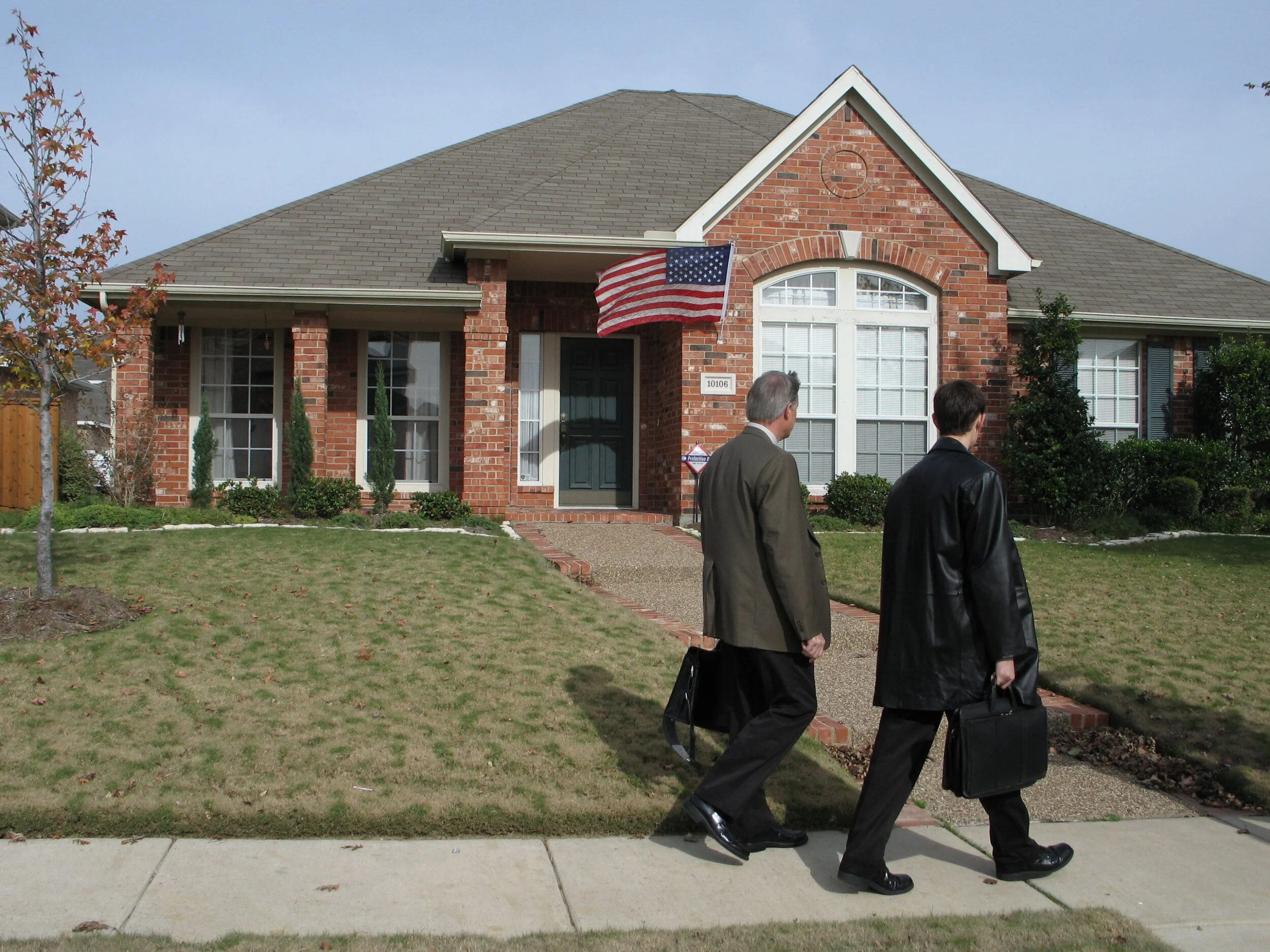
When my mom took me door-knocking on Saturday mornings to deliver the Watchtower magazine and a Bible message to the neighborhoods of Saginaw, Michigan, I didn't realize I was a defender of America's essential freedoms: speech, religion and personal liberty. I was just a kid, who would rather be home watching cartoons on television like the other kids. At that age, being raised as one of Jehovah's Witnesses was an embarrassment because it meant I was different. Getting sent to the principal's office for refusing to say the Pledge of Allegiance was not a typical third-grade offense. Now, as an adult who became a journalist but never joined the religion, I can see why it's important that Jehovah's Witnesses are different. That's why I wanted to make KNOCKING. Our essential freedoms are at war with each other -- a culture war. We are divided by the very principles that defined America. But when Jehovah's Witnesses knock, they are demonstrating that the freedoms of speech, religion and personal liberty can exist in harmony. It is how a Kingdom Hall of Jehovah's Witnesses, an abortion clinic and a gay married couple can peacefully co-exist on the same block. Jehovah's Witnesses are moral conservatives who only compete in the marketplace of ideas. They attempt to persuade -- not impose -- their beliefs at your door. If you say "no thanks," they won't go behind your back and amend the Constitution to suit their worldview. The only world they want to control is their own congregation, which is their right, and joining it is a personal choice. Jehovah's Witnesses keep religion out of politics. Their separation of church and state is absolute: they don't vote, pledge allegiance to the flag or serve in the military. Yet as otherwise law-abiding, tax-paying citizens, they remind us that the America worth fighting for is an America that does not force people to follow a single ideology with patriotic fervor. And as a group with fundamental religious beliefs, they remind us that it is possible to stand firm in your faith without feeling threatened by those who choose a different path. The knocking may be inconvenient, but it is a necessary annoyance in a free society. And when their own First Amendment rights were threatened, they went to the U.S. Supreme Court a record 62 times. Jehovah's Witnesses prevailed, winning 50 cases that expanded liberty for everyone -- even groups they disagree with. Now we can all equally share our own message. Better we hear an idea we don't like than be forced to live by it.

Director Commentary Video
In an exclusive interview with Beliefnet, Joel P. Engardio explains how the beliefs and behaviors of Jehovah's Witnesses have made an impact on society beyond the door step.

Click here to watch on Beliefnet.

Biography
Joel P. Engardio received the 2000 National Press Foundation award for science writing. In 2003, he was named best opinion writer by the Northern California Society of Professional Journalists. He was a finalist for the University of Missouri's 1999 national lifestyle writing awards in multicultural journalism. Engardio has written for the Los Angeles Times, New York Times, San Francisco Chronicle, San Francisco Weekly, Newsweek, Boston Globe, Christian Science Monitor and P.O.V. magazine. In television, Engardio worked as an associate producer for ABC News at the newsmagazine 20/20 and the network's documentary unit, Turning Point. Engardio also consults as a media and communications strategist for the American Civil Liberties Union. He graduated from Michigan State University, majoring in journalism and history. Engardio was born and raised in Saginaw, Michigan where his mom was the only member of a large Italian Catholic family to become one of Jehovah's Witnesses. Engardio currently lives in San Francisco.

By Tom Shepard
I am drawn to documentary filmmaking as a vehicle for telling untold stories and doing so in a way that won't trivialize or sensationalize the issues and subjects who appear on screen. There are few journalistic outlets left in our fast-paced society which allow us to relax into a story, meet engaging characters, and be taken on a journey that really challenges what we know and how we think about the world. KNOCKING is one of those outlets and was a privilege to co-direct. Most people have only a vague notion of who Jehovah's Witnesses are. Before making this film, I knew very little about them -- their beliefs, their history, their family life, and their ways of congregating. In KNOCKING, we tried to unpackage the stereotype of Jehovah's Witnesses as proselytizing zealots. By delving deeply and personally into the lives of several Witnesses, watching them struggle with life's biggest challenges, watching them celebrate deeply-held convictions, and watching them negotiate their faith in a world often at odds, even hostile, toward them, we begin to empathize and see Jehovah's Witnesses as real human beings, not just caricatures on our doorsteps. Once this happens, our minds open to important and rarely discussed information: how Witnesses paved legal precedents regarding First Amendment rights, how they modeled resistance to totalitarian authority in Nazi Europe, and how their unconventional beliefs prompted innovation in medicine that benefits all of us. Whether or not you agree with Jehovah's Witness beliefs, it is incumbent on you to know their story, to learn their history as it is part of your own history, and to take note of all the important ways they have intersected with society. I hope KNOCKING adds to this body of knowledge and gives its viewers pause before avoiding the door next time a Witness comes knocking.

Biography
Tom Shepard produced and directed SCOUT'S HONOR, an ITVS-funded documentary that won the Audience Award for Best Documentary and Freedom of Expression Award at the 2001 Sundance Film Festival, as well as several other awards including Grand Prize at the 2001 USA Film Festival. SCOUT'S HONOR broadcast nationally on the PBS series P.O.V. Previously, Shepard worked as an editor at National Public Radio for Linda Wertheimer and the NewsHour with Jim Lehrer. At NPR, he co-produced Listening to America, an audio documentary on the history of public radio in America, based on Linda Wertheimer's book by the same name. Shepard graduated from Stanford University where he majored in biology and film. He is currently directing a new film about child geniuses and science education. Shepard lives in San Francisco.