|
ABOUT JEHOVAH'S WITNESSES
JEHOVAH'S
WITNESS HISTORY
Charles Taze Russell
(1852-1916), the founder of what would
become modern-day Jehovah's Witnesses,
was born near Pittsburgh, Pennsylvania,
to a Presbyterian family. In July 1879
Russell launched Zion's Watch Tower and
Herald of Christ's Presence -- known
today as the Watchtower magazine. From a
first edition of 6,000 copies,
circulation quickly grew. In 1910
Russell established the International
Bible Students Association (IBSA),
creating the faint outlines of a
distinct religious community. (The IBSA
would later become known as Jehovah's
Witnesses.)
JEHOVAH'S
WITNESSES AND CIVIL RIGHTS
At the time Jehovah's
Witnesses brought several dozen cases to
the U.S. Supreme Court in the 1930s and
1940s, the Court had handled few cases
contesting laws that restricted free
speech and religion. The First Amendment
until then had been applied only to
Congress and the federal government. The
Witnesses brought a range of issues
before the high Court, including
mandatory flag salute, sedition, free
speech, literature distribution and
draft law. These cases proved to be
pivotal moments in the formation of
constitutional law. The decisions were
all the more remarkable because the
Court handed down many of them during
periods of national crisis and war.
JEHOVAH'S
WITNESSES AND BLOOD TRANSFUSIONS
Headlines often
reported about Witnesses and doctors
locked in battle over the right to
determine treatment. Witnesses sought
good medical care, but they flatly
refused blood transfusions for
themselves and their children on
religious grounds, even if critically
sick or injured. Doctors, not wishing to
be deprived of an important treatment
option, sometimes refused to treat or
operate on Witnesses. In cases of
life-threatening illness or injuries,
judges often issued emergency court
orders, allowing doctors to override
patient objections and transfuse if
necessary. Witnesses too went to court,
arguing for patient autonomy and the
patient's right of informed consent.
This tension between medical science and
religious conviction created ethical
dilemmas for medical professionals and
Witness patients alike.
JEHOVAH'S
WITNESSES AND THE HOLOCAUST
Jehovah's Witnesses
numbered about 35,000 in Germany and
Nazi-occupied lands. As they had before
Hitler assumed power, they attempted to
keep a "neutral" position toward
politics, refusing to take part in Nazi
rituals, elections or programs.
Witnesses, young and old, would not join
Nazi organizations, such as the Hitler
Youth and the Nazi Party. When military
service became mandatory, Witness males
refused to be inducted because they
would not kill. The Nazis arrested
thousands of Witnesses, men and women.
Many faced interrogations and torture.
About 13,400 were sent to Nazi prisons
and camps. Jehovah's Witness inmates
were identified by purple triangles on
their uniforms. Almost 2,000 Witnesses
died during the Hitler years. Of that
number were 270 Witness males, executed
for refusing to join the German army.
JEHOVAH'S
WITNESS BELIEFS
They won't go to war
or practice abortion, following the
conviction that life is sacred. But they
will risk their own lives in surgeries
without blood because they say refusing
blood transfusions pleases God. They
fight for their rights in courts, but
they keep out of politics. They go
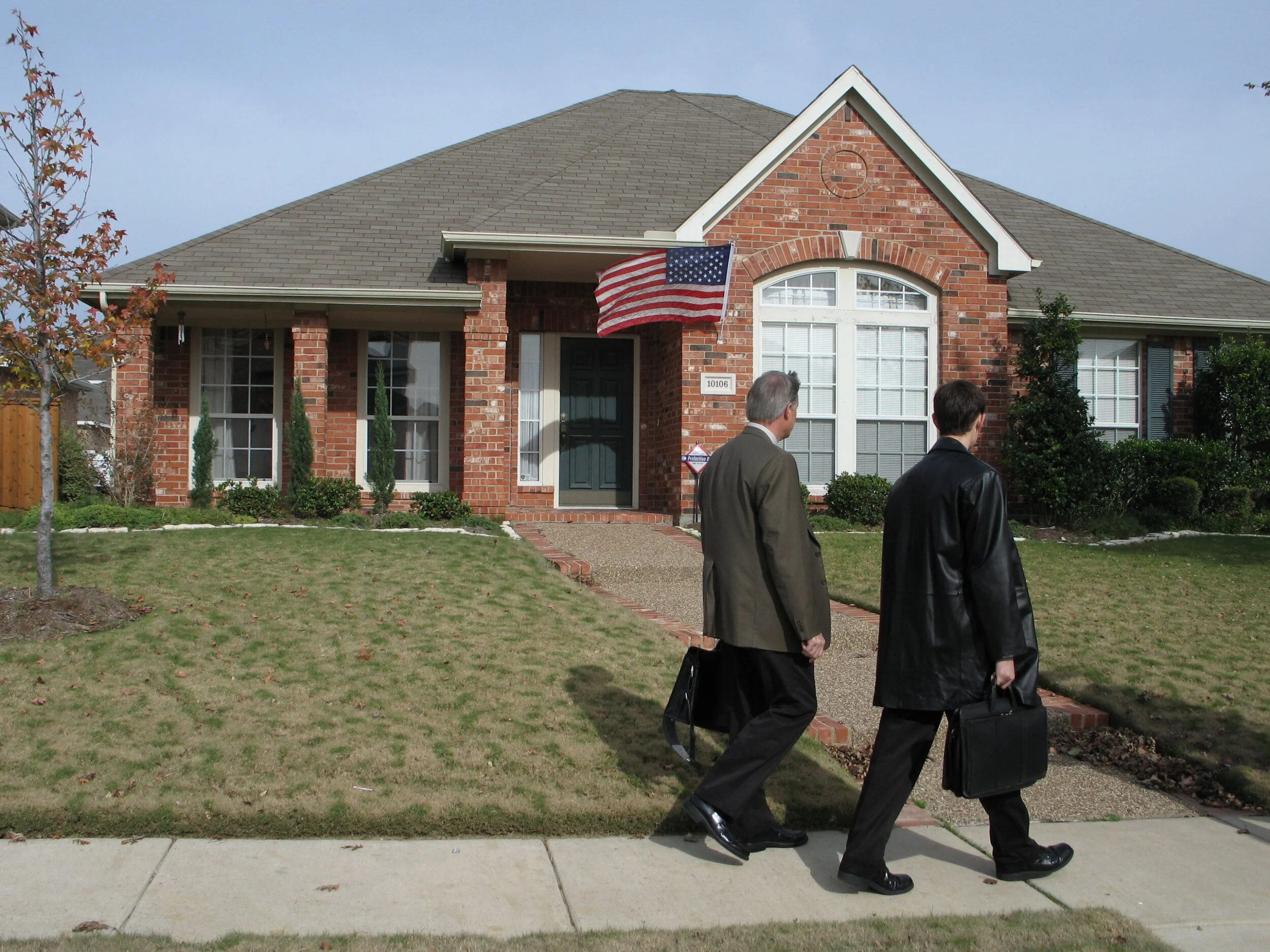
knocking to talk about Jesus, but they
won't celebrate his birthday. They try
to get people to join their faith, but
they expect to share their ultimate
reward of Earthly paradise with
non-Witnesses. As visible as Jehovah's
Witnesses are on doorsteps and street
corners, with their Watchtower and
Awake! magazines, people know
surprisingly little about what they
believe and why. In some ways Witnesses
follow mainstream Christian thought. But
much of their doctrine is unique among
Christian faiths. Like most religions,
the Witness belief system has evolved
over time, molded by their developing
interpretation of the Bible and by world
events.
JEHOVAH'S
WITNESS COMMUNITY STRUCTURE
Jehovah's Witnesses
are part of congregations, which meet in
Kingdom Halls. This house of worship is
not called a church. The Kingdom Hall is
a simple building with chairs,
classroom-style lighting and speaker's
platform. There are no images, special
furnishings or religious rituals. The
congregation is the center of spiritual
and social activity in the lives of most
Witnesses.
|